Understanding the Money Factor in Canadian Auto Leases in Toronto, ON
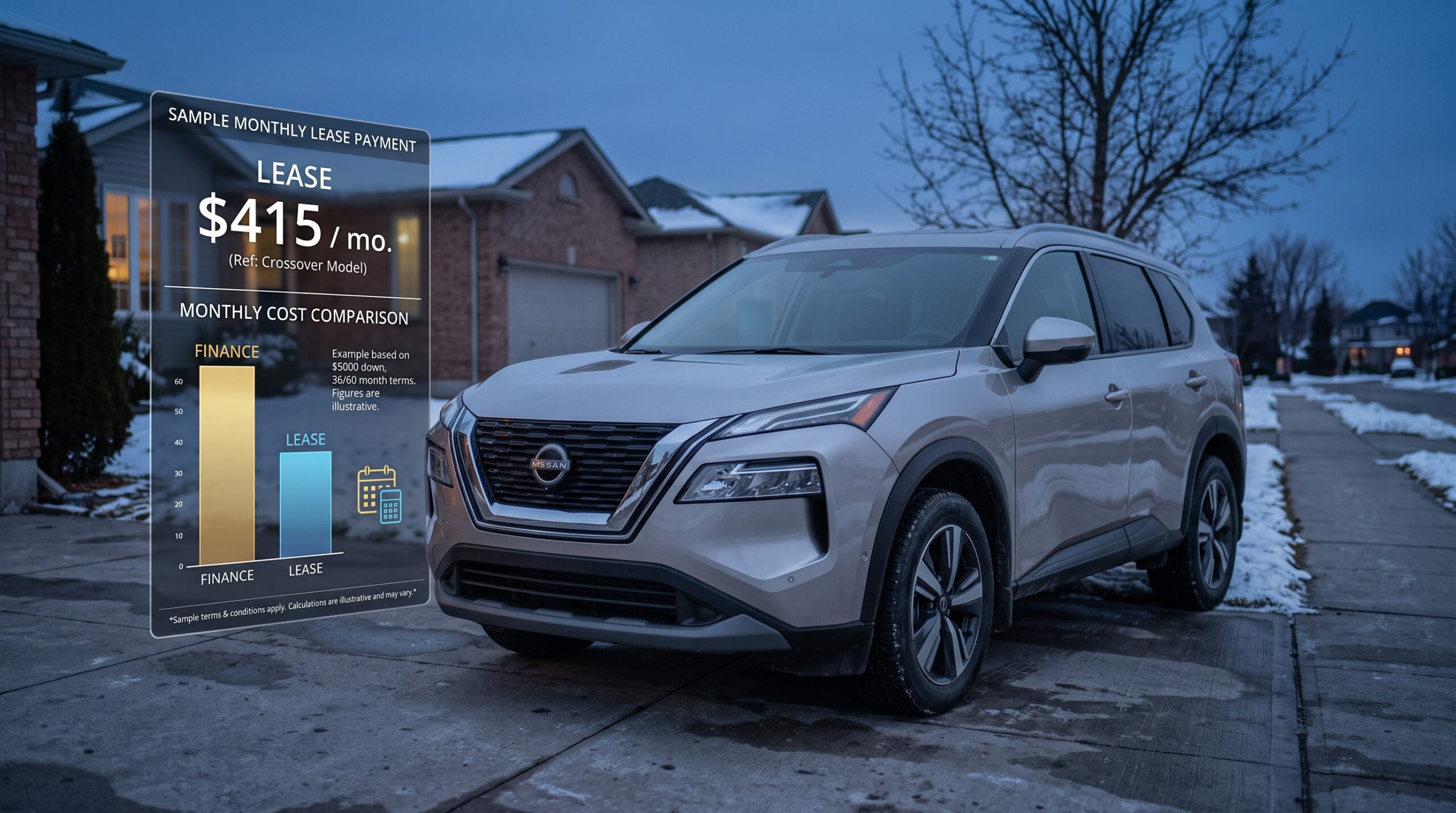
The money factor is the interest rate on a car lease, just written in a form most people don’t recognize. It looks like a small decimal — something like 0.00250 — and it’s applied to your capitalized cost plus residual value every month. Multiply that decimal by 2,400 and you get the equivalent annual percentage rate (APR). So 0.00250 is 6% APR, and 0.00125 is 3% APR. In Toronto, ON, where a base compact lease can run $450–$650 a month before tax, the money factor is often the difference between a deal that makes sense and one that quietly costs you $1,500–$3,000 over three years. This article explains how it works, how to convert it, how dealers mark it up, and what to check before you sign.
What the Money Factor Actually Is
A lease payment has three moving parts: depreciation, rent charge, and tax. The money factor sets the rent charge — the finance portion of the lease. It’s not a fee and it’s not negotiable in the way a purchase price is, but it is tied to your credit profile and the lender’s base rate. Dealers can mark it up within limits set by the manufacturer’s finance arm.
Here’s the structure of a typical monthly payment:
- Depreciation: (Cap cost − Residual value) ÷ lease term. This is the largest piece.
- Rent charge: (Cap cost + Residual value) × money factor. This is the finance cost.
- Tax: Applied on the monthly payment in Ontario (13% HST).
Notice the rent charge uses the sum of cap cost and residual, not the difference. That’s why a lease with a high residual can still carry a meaningful finance cost — you’re paying interest on the full value of the car, not just the portion you use.
How to Convert Money Factor to APR
The conversion is simple and you should do it every time you see a money factor quoted. Multiply by 2,400.
| Money Factor | Equivalent APR | Typical Situation |
|---|---|---|
| 0.00083 | 2.0% | Subvented rate, strong credit |
| 0.00125 | 3.0% | Standard promotional rate |
| 0.00208 | 5.0% | Average market rate |
| 0.00292 | 7.0% | Marked-up rate, mid credit |
| 0.00375 | 9.0% | High markup or weaker credit |
On a $45,000 vehicle with a $25,000 residual over 36 months, the difference between 0.00125 and 0.00292 is roughly $80 a month. That’s $2,880 over the term — more than a full set of winter tires, insurance, and a service plan combined.
Why Toronto Lease Rates Differ From the Rest of Canada
Manufacturer lease programs are national, but the effective cost in Toronto, ON tends to run higher for a few practical reasons. Dealership volume is high, which can work in your favor on the selling price, but the money factor itself usually comes from the same national program. Where Toronto buyers get hit is on add-ons and markup.
Dealer markup on the base rate
Most lenders allow the dealer to bump the money factor by 0.00040 to 0.00080 (roughly 1% to 2% APR) and keep the difference as profit. On a 36-month lease, a 0.00050 markup on a $45,000 car costs you about $1,000. Ask what the base rate is and whether the quoted number includes markup.
Add-ons that inflate the cap cost
Fabric protection, paint sealant, tire and rim coverage, and window etching get rolled into the capitalized cost. Each $1,000 added to cap cost raises the monthly payment by roughly $28 on a 36-month lease at 6% APR. In a dense city with potholes and street parking, tire and rim coverage can be worth it — but it should be a decision, not a default line item.
How the Money Factor Fits Into the Full Lease Calculation
You can’t evaluate the money factor in isolation. A low rate on an inflated selling price is worse than a slightly higher rate on a discounted one. Work through the whole equation.
- Step 1: Get the negotiated selling price (cap cost) before any trade-in or down payment.
- Step 2: Confirm the residual value and residual percentage for your term and annual kilometers.
- Step 3: Ask for the money factor and convert it to APR.
- Step 4: Calculate depreciation: (cap cost − residual) ÷ months.
- Step 5: Calculate rent charge: (cap cost + residual) × money factor.
- Step 6: Add the two, apply 13% HST, and compare against the dealer’s quoted payment.
If the numbers don’t match, ask which variable changed. Nine times out of ten it’s an add-on buried in the cap cost or a marked-up rate.
Money Factor vs. Interest Rate: What’s the Difference in Practice
Functionally, they’re the same thing expressed differently. The APR is what you’d see on a loan; the money factor is the lease-specific format. The reason it matters is transparency — because it’s written as a decimal, many buyers don’t recognize it as an interest rate and skip negotiating it.
On a loan, you can shop the rate at your bank. On a lease, you’re limited to the manufacturer’s finance arm or a third-party lessor the dealer works with. That closes the shopping loop, which is exactly why the money factor is worth pushing back on. It’s one of the few lease variables where a polite, informed question can save real money.
How Credit Score Affects Your Money Factor in Ontario
Lenders tier lease rates by credit score. In Ontario, the general pattern looks like this:
- 720+: Best tier, often the subvented or promotional rate.
- 680–719: Standard tier, small bump over the base.
- 640–679: Mid tier, noticeable increase.
- Below 640: Higher tier or a requirement for a larger security deposit.
If you’re near a tier boundary, a small score improvement — paying down a credit card balance, correcting an error on your report — can move you into a better rate before you sign. On a 36-month lease, one tier can be worth $600–$1,200.
Lease Takeovers: A Different Way to Avoid the Money Factor Trap
When you take over an existing lease, the money factor was already locked in by the original lessee — often at a rate from one, two, or three years ago. In a higher-rate environment, that’s an advantage. You inherit the original terms, the remaining months, and the original monthly payment.
On a marketplace like Car Lease Canada, you can browse lease takeovers across Toronto, ON and the rest of the country, compare monthly payments side by side, and contact the current lessee directly. The trade-off is that you don’t choose the vehicle spec — you take what’s listed — but you also skip the negotiation, the dealer markup, and the freight and PDI fees on a new car.
What to check before assuming a takeover:
- Remaining term and kilometers per year — make sure the allowance fits your driving.
- Current odometer reading vs. the allowance at this point in the term.
- Any wear-and-tear or excess kilometer liability you’d inherit.
- Whether the lessor charges a transfer fee, and who pays it.
- Whether the original lessee is offering an incentive to take over the payment.
For someone who needs a car for 12–24 months in Toronto and doesn’t want to commit to a full new-lease term, a takeover often pencils out better than a new lease at today’s rates.
Common Mistakes That Cost Toronto Lessees Money
Negotiating the payment instead of the variables
Dealers love a monthly payment conversation because it hides the inputs. Negotiate the selling price first, then the rate, then the term. Never quote a target payment — it tells the dealer exactly where to bury the markup.
Ignoring the residual and kilometers
A high residual lowers your monthly payment but can leave you with negative equity if you want to buy out or trade early. A low kilometer allowance (16,000/year instead of 20,000) lowers the residual slightly but can trigger excess kilometer charges at $0.10–$0.20/km. If you drive 22,000 km a year, that’s $600–$1,200 annually in overage.
Skipping the total cost of borrowing disclosure
Ontario lease agreements must disclose the total cost of borrowing. Read it. It’s the cleanest single number for comparing two lease offers, and it captures the money factor, fees, and term length in one figure.
Questions to Ask Before You Sign
- What’s the base money factor, and is there dealer markup on it?
- What’s the residual percentage for this term and kilometer allowance?
- Which add-ons are in the cap cost, and can each be removed?
- What’s the total cost of borrowing on this contract?
- What happens if I exceed the kilometer allowance, and at what rate?
- Is there a lease-end purchase option, and at what price?
Ask these in writing over email if possible. It’s harder to change a number once it’s in print.
Frequently Asked Questions
Is a lower money factor always a better deal?
No. A low money factor on a car with a weak residual or an inflated selling price can cost more than a slightly higher rate on a discounted vehicle. Compare total cost of borrowing, not just the rate.
Can I negotiate the money factor in Toronto?
You can push back on dealer markup, but not on the lender’s base rate. Ask what the base rate is, then ask them to remove the markup. On a competitive deal, many dealers will.
Does a lease takeover come with a new money factor?
No. You assume the original contract terms, including the original money factor and monthly payment. That’s often the main financial advantage of a takeover when current rates are higher than they were when the lease started.
Bottom Line
Understanding the money factor in Canadian auto leases in Toronto, ON comes down to three habits: convert it to APR (multiply by 2,400), ask whether dealer markup is included, and evaluate it alongside the selling price and residual rather than on its own. A 0.00100 difference is worth roughly $50–$90 a month on a typical mid-range vehicle — real money over a 36- or 48-month term. If current rates feel steep, a lease takeover is a legitimate alternative that lets you inherit a lower locked-in rate, and you can browse current listings at Car Lease Canada to see what’s available. Either way, run the numbers before you sign, not after.
Visit Car Lease Canada












Post Comment