Eyebrow Threading Guelph: How to Communicate the Perfect Arch to Your Threader
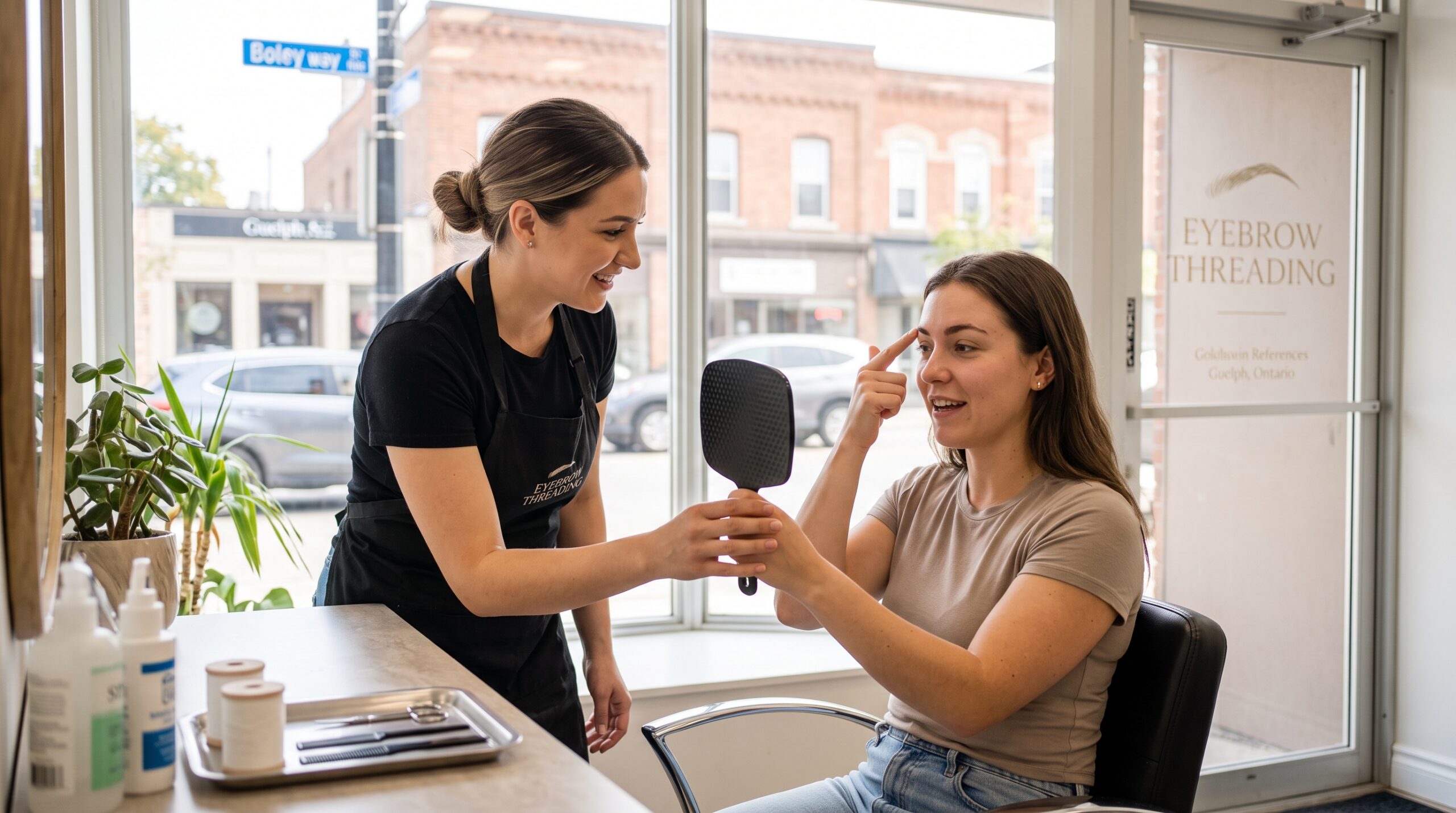
Getting the arch you actually want comes down to three things: bringing a reference, knowing the vocabulary threaders use, and speaking up before the first thread leaves the brow. Most disappointing eyebrow threading in Guelph, ON isn’t caused by bad technique — it’s caused by a mismatch between what you pictured and what your threader understood. This guide gives you the exact words, measurements, and questions to use so your next appointment ends with the shape you had in mind.
Why the Consultation Matters More Than the Threading
Threading is fast. A full brow can take ten to fifteen minutes, and the actual shaping happens in the first two. That’s why the thirty seconds before the thread starts matter more than anything else.
A good threader will look at your brows, your bone structure, and your natural growth pattern, then propose a shape. Your job is to confirm or redirect before they begin. Once hair is removed, you’re waiting three to four weeks to fix an over-thinned arch — and if the tail got shortened, that wait feels much longer.
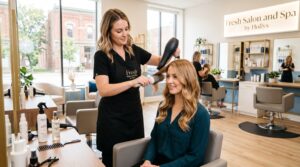
If you’ve never had a consultation at a new salon, ask for one. At a spa that offers both hair and esthetics, like Fresh Salon and Spa By Hollys in Guelph, the front desk can usually book you a few extra minutes with the esthetician so you’re not rushed into the chair.
The Vocabulary: Words Your Threader Actually Uses
Vague requests get vague results. “Just clean them up” means something different to every threader. Learn these terms and you’ll get closer on the first try.
- Arch height — how high the peak of the brow sits above the brow bone. High arches look dramatic; low arches look softer and more natural.
- Arch position — where the peak falls. Two-thirds out from the inner corner is the classic placement. Closer to the middle reads as surprised; too far out reads as flat.
- Tail — the outer end. Length and taper here change your whole eye shape.
- Brow head — the inner start. Threaders control how square or rounded this is.
- Thickness — how much hair stays under the arch. This is the single most common source of regret.
- Bulb — the fullest part, usually just before the arch.
- Stray — hair outside the main shape. Removing strays is different from reshaping.
Say it in one sentence
Try: “Keep the thickness, raise the arch slightly, and don’t touch the tail length.” That’s a complete instruction. Compare it to “make them look better,” which gives your threader nothing to work with.
Bring a Reference Photo — But the Right One
Photos help, but only if they’re useful. A red-carpet close-up of someone with a completely different brow density will set you up for disappointment.
What works better:
- A photo of yourself from a time you liked your brows. This is the gold standard because it accounts for your natural growth.
- A photo of someone with a similar brow thickness and eye shape, not just a similar face.
- Two photos: one showing the arch you want, one showing the thickness you want. Sometimes those are different people.
Skip photos with heavy makeup, filters, or drawn-on brows. You’re asking a threader to replicate a shape, not a product.
What to point out in the photo
Don’t just hand over your phone. Say what you’re seeing: “I like how the arch sits here,” pointing at the peak, “and I want to keep this much hair underneath.” Threaders read faces for a living — a specific pointer saves everyone time.
Reading Your Own Brow Bone Before You Go
Your natural brow bone sets the ceiling on arch height. You can raise an arch a little, but you can’t create a peak that isn’t supported by the bone underneath without it looking drawn on.
Do this at home: look straight into a mirror, place a finger along the top edge of your brow bone, and follow it outward. The highest point of that ridge is roughly where your arch should peak. If you’ve been asking for arches higher than that ridge, that’s likely why previous appointments felt off.
Also check your natural growth direction. Hair near the brow head grows upward and outward; hair at the tail grows downward and outward. A threader working against that pattern creates gaps that take weeks to fill.
How to Describe Arch Height and Thickness Precisely
Numbers beat adjectives. Here’s a practical way to be specific without overthinking it.
| What you want | What to say |
|---|---|
| Subtle change | “Clean up strays only, keep the shape exactly as is.” |
| Slightly higher arch | “Raise the peak by about 1–2 mm, no more.” |
| Fuller brows | “Leave the thickness under the arch — remove only what’s clearly outside the line.” |
| Longer tail | “Extend the tail slightly, keep it tapered, don’t shorten it.” |
| Softer look | “Lower the arch and round the brow head.” |
One millimetre sounds trivial. On a brow that’s roughly 25–30 mm long, it’s visible. Threaders work at that scale all day, so they’ll understand the instruction.
Ask for a mirror check mid-service
Most threaders will pause and hand you a mirror after the first pass. Take it. Look at the shape before they continue. It’s much easier to say “a little more off the top” at that point than to grow it back.
Common Mistakes That Lead to the Wrong Arch
These come up constantly, and all of them are avoidable.
- Asking for “thin brows.” Thin is a one-way street. Threaders can always remove more next visit; they can’t add it back today.
- Staying silent when something looks wrong. Speak up during the appointment, not in the car afterward.
- Booking a new threader right before an event. Give yourself at least a week of buffer for a first appointment with anyone new.
- Comparing your brows to someone else’s. Density, growth pattern, and bone structure differ. A good shape for your face may not match the photo.
- Skipping the between-visit maintenance. Tweezing the obvious strays at home keeps the shape intact so your threader isn’t rebuilding from scratch every time.
If you’re recovering from an over-thinned brow, tell your threader that up front. They’ll adjust the plan and may suggest leaving more hair than usual for two or three cycles.
What It Costs and How Long It Takes in Guelph
Eyebrow threading in Guelph generally runs in the range you’d expect for a mid-size Ontario city — typically less than a brow wax at a comparable salon, and the appointment itself is short. Pricing at full-service salons often depends on the experience level of the service provider, so the same service can carry different rates depending on who performs it.
At Fresh Salon and Spa By Hollys, services are priced by a level system based on the provider’s industry experience and client demand, with levels ranging from Entry through Level 4AA. If you’re booking threading alongside another service, ask which level your esthetician is at so you know the rate before you arrive. First-time clients sometimes assume all providers cost the same — they don’t.
Timing-wise, plan for fifteen minutes for a standard brow, twenty to twenty-five if you’re also having upper lip or chin threaded. Add five minutes if you want a full consultation with a new threader.
Questions to Ask Before Your First Appointment
A short list worth running through when you book:
- Can I request a specific esthetician, and does that change the price?
- Do you offer a consultation before the first threading?
- What’s your cancellation policy if I need to reschedule?
- How do you handle brows that have been over-thinned or over-waxed?
- Do you thread other areas, in case I want to book more than brows?
Booking online or by phone both work, but if it’s your first visit and you have specific shape goals, call. It’s easier to explain what you want to a person than to type it into a notes field.
Frequently Asked Questions
How often should I get my eyebrows threaded?
Every three to four weeks suits most people. If you’re growing out an over-thinned brow, stretch it to four or five weeks so there’s enough regrowth to reshape properly.
Does threading hurt more than waxing?
Most people find threading slightly more uncomfortable during the service but easier on the skin afterward, since no hot wax touches the brow area. Taking an ibuprofen twenty minutes before can help if you’re sensitive.
Can I get the arch I want if my brows are naturally flat?
You can raise the arch modestly, but the brow bone sets the limit. A threader can create the illusion of more lift by tapering the tail and cleaning underneath the arch, but forcing a high peak on a flat bone usually looks unnatural and grows back unevenly.
Getting the Shape You Want, Every Time
Communicating the perfect arch isn’t about finding a secret phrase — it’s about being specific, checking the mirror mid-service, and telling your threader what you liked last time. Bring a photo of yourself, use the vocabulary above, and never let anyone thin your brows without your clear go-ahead. If you’re in Guelph, ON and want a threader who’ll take the time to get the shape right, book a consultation and come prepared with a reference. A two-minute conversation now saves a month of waiting for your brows to grow back.









Post Comment